
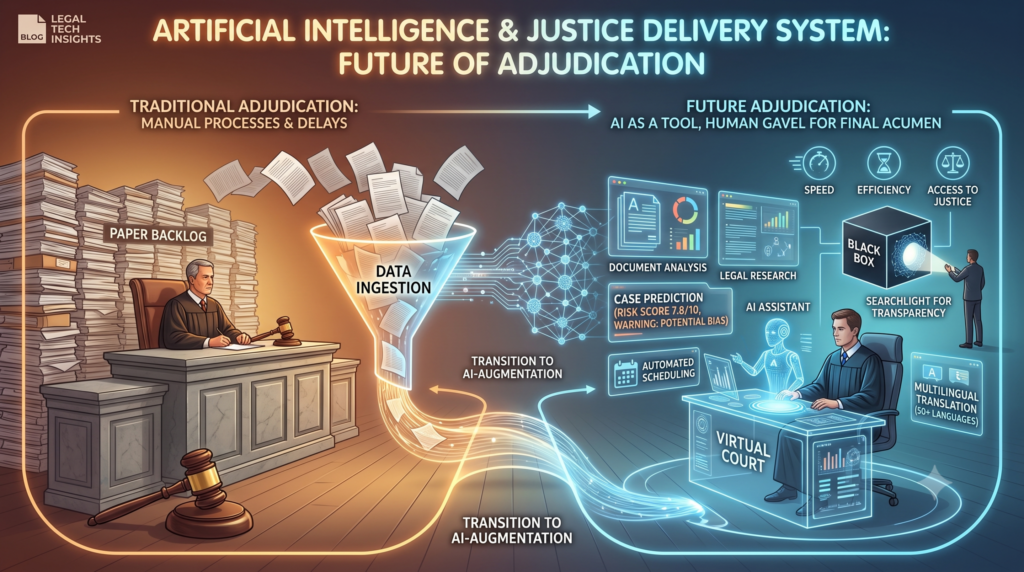
Artificial Intelligence and Justice Delivery System: Future of Adjudication
The blog “Artificial Intelligence and Justice Delivery System: Future of Adjudication” is written by Mr.Saptarshi Sinha, Students of Batch B-9/ Semester- 6th of MIES R M Law College under the guidance of Mr. Soumik Ash , Asst Prof of MIES R.M. Law College affiliated to Vidyasagar University,
At MIES R M Law College, Sonarpur, South Kolkata—one of the leading law colleges in West Bengal—students gain in-depth knowledge of constitutional rights and social justice through its 3-year law program. As a Bar Council of India–approved institution affiliated with Vidyasagar University, the college offers quality legal education in India, supported by an active placement cell, regular internship opportunities, and a well-equipped campus with modern facilities that enhance both academic and professional growth.
Artificial Intelligence and Justice Delivery System: Future of Adjudication
Introduction to Artificial Intelligence and Justice Delivery System
The twenty-first century has witnessed an unprecedented growth of Artificial Intelligence (AI) across various sectors, including healthcare, education, finance, and governance. The legal system has also begun exploring the possibilities offered by AI to improve efficiency, reduce delays, and enhance access to justice. Courts around the world are increasingly adopting technology-driven solutions to manage growing caseloads and administrative burdens.
Understanding Artificial Intelligence in the Legal Context:-
Artificial Intelligence (AI) is increasingly being used in the Indian legal sector, including within courts, often via experimental or “shadow” forms of use. While properly governed AI systems can improve access to justice, support the Sustainable Development Goals and strengthen institutional performance, their adoption must be underpinned by clear governance frameworks, transparency, and safeguards rooted in rights-based principles.
Drawing from stakeholder interviews with judges, court staff, legal-tech founders, and academics, the report provides an overview of digitization and the current use of AI in Indian courts, analyses AI use cases, identifies risks and potential violation of rights, including privacy, fair trial, and equality. It proposes a four-part assessment process for courts to evaluate their institutional readiness, identify rights-based risks, request a technical evaluation of the proposed AI tool, and establish monitoring mechanisms for assessing the performance and impact of AI tools. These assessments are anchored in constitutional principles and global best practices.
Advantages of AI in Delivering Justice: –
1. Speed and Efficiency: –
AI can process enormous volumes of information within a short period and assist judges and lawyers in legal research. AI tools (like India’s Supreme Court “SUPACE“ and translation software “SUVAS” assist in transcribing court proceedings, summarizing heavy volumes of documents, and organizing intelligent cause.
2.Improved Access to Justice: –
Technology can provide affordable legal assistance and information to a larger population. The judiciary faces longstanding challenges such as case backlogs, language barriers, and the need for digital modernization. AI-powered technologies—including Machine Learning (ML), Natural Language Processing (NLP), Optical Character Recognition (OCR), and Predictive Analytics are now being leveraged to automate administrative tasks, improve case tracking, and enhance crime prevention.
Initiatives like e-Courts Project Phase III, AI-assisted legal translation, predictive policing, and AI-driven legal chat bots are reshaping the legal landscape, making processes faster, smarter, and more transparent. While the adoption of AI presents challenges, particularly in data security, ethical governance, and legal adaptation, its potential to strengthen India’s justice system is unparalleled.
This article explores the transformative role of AI in India’s judiciary and law enforcement, highlighting its applications, impact, and future potential in ensuring a more efficient, transparent, and citizen-centric justice system.
The e-Courts Project, initiated under the aegis of the Supreme Court of India, is a transformative initiative aimed at modernizing judicial functions through digital innovation. In Phase III, the project integrates advanced Artificial Intelligence (AI) solutions to enhance case management and administrative efficiency across courts in India. This phase builds on earlier digital transformation efforts to deliver a more responsive and effective judicial system.
3. Automated Case Management: –
AI-driven tools are now deployed for smart scheduling, case prioritization, and proactive backlog reduction. These systems use predictive analytics to forecast potential delays and adjournments, ensuring that judicial resources are optimally allocated for timely case resolution.
4. AI in Legal Research and Documentation: –
Advanced AI-powered tools assist judges and lawyers by streamlining legal research, identifying relevant case precedents, and summarizing judgments. This technology not only expedites the research process but also enhances the quality and consistency of legal documentation.
5. AI-Assisted Filing and Court Procedures: –
The integration of Optical Character Recognition (OCR) and Natural Language Processing (NLP) is revolutionizing document digitization. These technologies automate the filing of court documents, ensuring faster processing and reducing manual errors in the documentation process.
6. AI for User Assistance and Chatbots: –
AI-driven virtual legal assistants and chat bots are available to provide litigants with real-time information on case status, procedural guidance, and essential legal updates. This round-the-clock digital support makes the judicial system more accessible and user-friendly, especially for individuals unfamiliar with legal procedures.
7. AI for Predictive Analysis in Case Outcomes:-
AI models analyze historical judgments and case data to offer predictive insights into potential case outcomes and risk assessments. This capability helps judicial officers to formulate more informed decisions and develop effective case strategies, contributing to a proactive judicial framework. In the era of the AI revolution, the usage of AI implies high machine learning to reduce time and cost with high efficiency and productive functioning of judicial institutions. The remarkable tenure of Chief Justice D.Y. Chandrachur has seen the introduction of technology in the judiciary system.
The fusion and introduction of AI in judiciary activities have revolutionized the way the judiciary system works in India. The positive outcomes of technology usage have been documented by the Madras High Court, which demonstrated an exceptional case clearance rate of 114% in 2022, surpassing the high court case clearance rate. The introduction of AI tools like “SUPACE” and “SUVAS” in the Indian Judiciary System and increased usage of technology in communicating, delivering, and providing easier and more understandable judgments (with translations of decisions to regional languages by SUVAS) have made the institution function more productively and efficiently, leading to faster delivery of judgments and reducing regional and linguistic disparity in a country like India with a multi-linguistic culture.
Debate on AI in the Judiciary: Evaluating Trust, Reliability, and Accountability
The use of Artificial Intelligence by the judiciary system can be both beneficial and dangerous (if not anchored in the8. reliability and trustworthiness of the designer or developer of the particular AI tool used in the Judiciary).
A Case Analysis: The Promise of AI for US Immigration Law:-
The immigration courts are struggling with challenges that seem to call for an AI solution. The immigration court backlog has exploded over the past few years, multiplying eight times in size between 2017 and the present, and is still growing. AI could, very likely, clear this backlog faster than the current judiciary.
Studies have also shown that there is significant variability in immigration court decisions that cannot be explained by merits of a case. These disparities have been documented in several national contexts and across all levels of adjudication, though some of the most dramatic disparities have been observed at the level of immigration judge decisions in the US. Many studies have shown that partisan politics, gender and the local politics of immigration have something to do with these decisions, but the variation documented by other studies is large enough to suggest that there are patterns of decision making that are idiosyncratic to each judge.
This is another problem that would seem to call for an AI solution. One of AI’s most touted advantages is its ability to process vast amounts of legal data quickly and consistently. Machine learning models can analyze precedents, identify patterns in judicial decisions, and even predict case outcomes with impressive accuracy. Courts have begun using AI-driven risk assessment tools to determine bail and parole eligibility, aiming to replace subjective human judgment with data-driven recommendations. Keeping this all in mind, it could be possible to construct an algorithm that corrects the wide variability in immigration judge decisions, using benchmarks that are weighted to ensure that decisions across court districts, and between judges, are normally distributed.
The potential benefits of AI, that I’ve discussed above, can be summarized as follows regarding Artificial Intelligence and Justice Delivery System
Efficiency: AI can review contracts, legal briefs, and case law in seconds, saving attorneys and judges countless hours. It’s hard to deny that the speed of AI would help to clear up the current immigration court backlog.
Consistency: Unlike human judges, AI does not experience fatigue, stress, or emotional bias, leading to more uniform decisions, and as noted above, there is a lot of unexplained variability in immigration judge decisions.
Access to Justice: AI-powered legal chat bots and automated services can provide legal guidance to those who cannot afford an attorney. This value-add is especially relevant for immigration law, considering that the vast majority of immigrants with newly docketed cases have no legal counsel.
However, while these benefits are promising, they come with significant caveats.
The claim that AI eliminates human bias assumes that algorithms operate in a vacuum. In reality, AI systems are only as fair as the data they are trained on. If historical legal decisions contain biases — which they inevitably do — then AI trained on this data will reproduce and even reinforce those biases.
For instance, many jurisdictions use AI-driven risk assessment tools to evaluate a defendant’s likelihood of reoffending. Studies have shown that these tools often disproportionately flag individuals from marginalized communities as high-risk, not because they are inherently more likely to reoffend, but because historical policing and sentencing data reflect systemic racial and socioeconomic disparities.
On the other hand, AI-driven decision making process can also be problematic because they are too abstract and don’t sufficiently account for all relevant contextual factors.
Let’s return to the example of immigration law. It could be possible for AI to “flatten out” the well-documented disparities in immigration judge decisions by ensuring that cases with similar characteristics would receive similar decisions, across all jurisdictions. The problem with this approach, however, is that it would overlook case details–that a seasoned immigration judge would notice, but would be ignored by a machine-learning algorithm–because these nuanced details cannot be converted into standardized indices for comparison across court decisions.
Although AI can assist in legal analysis and case management, it cannot fully replace human judges. Judicial decision-making often requires ethical reasoning, discretion, compassion, and contextual understanding. The Future of AI in Law: A Tool, Not a Judge.
Despite these challenges, AI’s role in the legal system is unlikely to diminish. The key question is not whether AI should be used in the legal process, but how it should be used.
It also bears noting that there is an AI and the Law research community that has been asking (and answering) questions like this for many decades. The two major hubs for this research include the European JURIX conference and the International Conference on AI and Law, which both originated in the late 1980s.
It’s not possible to summarize all of the best practices that have been distilled by these conferences in just a few sentences. However, there is one point on which most researchers in the AI and Law community agree, which is that AI tools for the legal community work best when the people who use these tools are involved in their design. Semantic Web Ontology and Web Ontology Languages (or OWLs; think Harry Potter meets AI) have been at the center of this paradigm shift in AI development, which has been underway for some time.
To sum up, AI should be viewed as a ‘supplementary tool rather than a substitute’ for human judgement. While it can assist legal professionals by providing data-driven insights, it should not be relied upon as the final arbiter of justice. Judges, attorneys, and policymakers must remain actively engaged in interpreting AI-generated recommendations, questioning their validity, and ensuring they align with ethical and constitutional principles.
Applications of AI Justice Delivery System in India
Translation and Transcription: –
Software applications such as SUVADC (Supreme Court Vidhi Anuvad Software) facilitate the translation of judicial decisions into numerous regional languages throughout India, whereas advanced natural language processing technologies enable real-time transcription services for courtroom proceedings and legal arguments.
Research and Efficiency:
Software platforms including SUVADC (Supreme Court Vidhi Anuvad Software) serve to convert judicial determinations into multiple regional languages across India, while sophisticated natural language processing systems provide instantaneous transcription capabilities for courtroom activities and legal discourse.
Ecosystem Integration:
Artificial intelligence facilitates integration with the Inter-operable Criminal Justice System (ICJS), establishing comprehensive connectivity among law enforcement agencies, forensic laboratories, correctional facilities, and judicial institutions through standardized data frameworks.
Conclusion of Artificial Intelligence and Justice Delivery System
AI has the potential to transform immigration law, and the entire legal system, in profound ways, offering efficiency, consistency, and greater accessibility to legal resources. However, it also introduces new challenges, particularly in the areas of bias, reliability, transparency, and accountability. The pursuit of justice is not merely a technical problem — it is a fundamentally human endeavor.
If AI is to have a place in the legal system, it must be implemented with caution, an unwavering commitment to fairness and sensitivity to user-relevant structures of meaning (which can be accommodated by Semantic Web Ontology). AI doesn’t have to be a one-size fits all solution that ignores individual needs, professional values and organizational mandates. Similarly, the law is not just about data points and predictive models; it is about human dignity, moral reasoning, and the social contract. In our rush to embrace AI, we must not lose sight of these principles.
As we move forward, the legal community must lead the conversation about AI governance, ensuring that technology serves justice rather than subverts it. The future of AI in the law should not be about replacing human judgment — but about enhancing it in ways that align with our deepest legal and ethical values.
Artificial Intelligence can significantly strengthen the administration of justice by improving efficiency, reducing costs, and increasing accessibility. However, justice is not merely a technical process. Human judgement, empathy, constitutional values, and ethical reasoning remain essential. Therefore, AI should function as an aid to judges rather than a replacement for them.
MIES R M Law College, Sonarpur, South Kolkata, contribute significantly to this mission by nurturing future legal professionals who are equipped to address issues of education, social justice, and public policy. As a Bar Council of India–approved law college affiliated with Vidyasagar University, the institution emphasizes both academic excellence and practical exposure, preparing students for careers in law, governance, and advocacy. By fostering awareness and critical understanding of fundamental rights like education, MIES R M Law College plays a vital role in shaping a more just, informed, and inclusive society.