The Right to Protest and its Constitutional Standpoint
The blog “The Right to Protest and its Constitutional Standpoint” is written by Mr Debanjan Majumder, Senior Asst Prof of MIES R.M. Law College affiliated to Vidyasagar University,
At MIES R M Law College, Sonarpur, South Kolkata—one of the leading law colleges in West Bengal—students gain in-depth knowledge of constitutional rights and social justice through its 3-year law program. As a Bar Council of India–approved institution affiliated with Vidyasagar University, the college offers quality legal education in India, supported by an active placement cell, regular internship opportunities, and a well-equipped campus with modern facilities that enhance both academic and professional growth.
Introduction to The Right to Protest
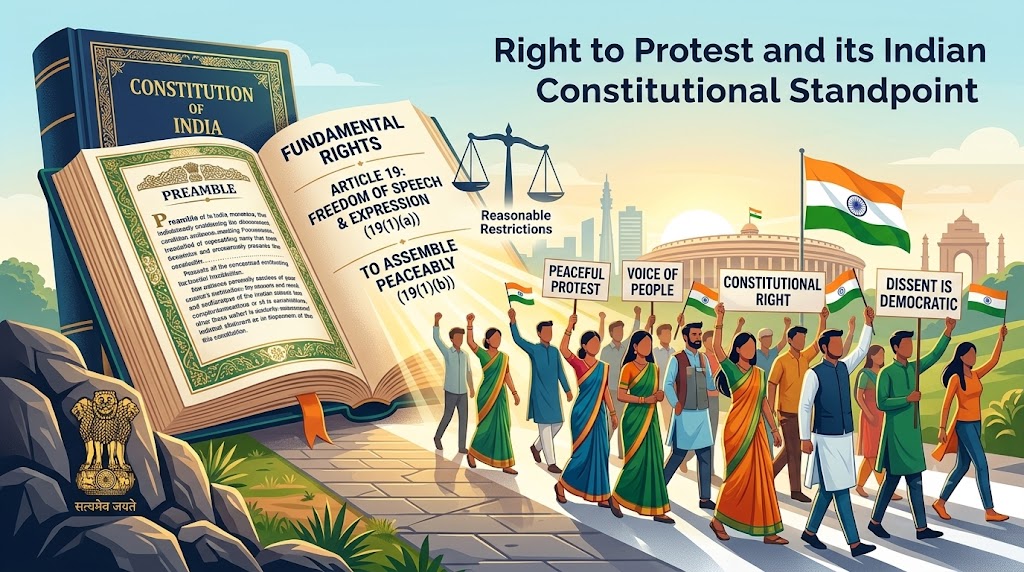
The Indian constitution does not expressly endow its citizens with the right to protest. Instead, as the Supreme Court has interpreted it, the right to some form of peaceful demonstration comes within the purview of ‘right to free speech and expression’ as provided in Article 19(1)(a) and right to peaceful assembly as provided in Article 19(1)(b). Indian courts have repeatedly upheld the value of peaceful protest in theory while allowing the substantial attenuation of the same in practice, especially where such protest is depicted as a competition between the right to protest and public order10 representing a judicial preference for order over dissent rather than a mere doctrinal inconsistency.
The Constitutional Foundation: Assembly, Expression, and Their Early Limits
From the beginning, the Supreme Court has recognized peaceful protest as a right of constitutional significance, however not an absolute one. In Kameshwar Prasad v. State of Bihar (1962), the Supreme Court struck down Rule 4A of the Conduct of the Government Servants of Bihar on the ground that it forbade all demonstrations by the government servants with respect to their service conditions.
Since the rule curtailed speech and assembly, the question arose whether the rule can be maintained as a reasonable restriction under the “public order” ground in Articles 19(2) and 19(3). The State deliberated that orderly conduct on the part of government officials was a sine qua non of public order, and allowing them to create disorder by agitating would only hamper public morale and disrupt public order. A demonstration, the Court ruled, can be construed as “speech and expression” as per Article 19(1)(a) of the Constitution and also as a “peaceful assembly” as per Article 19(1)(b) of the Constitution.
The judgment of Kameshwar Prasad
The judgment of Kameshwar Prasad thus does not lay down an unfettered right to protest. It lays down a limited but an important principle which is that a restriction based on discipline and demoralisation alone and not on any immediate danger of disorder cannot be said to be “reasonable.” That is, restrictions of public order cannot be used as prohibitions on protest. The important question, therefore, is not whether the State can restrict protest marches; Articles 19(2) and 19(3) provide for this without doubt. It is whether judicial scrutiny of restrictions imposed for public order purposes is stringent enough in relation to their necessity, scope, and impact, or whether the courts simply accept the definition of disorder provided by the State without examining the issue of proximity and proportionality as the law requires. This development forms the substance of the discussion in the succeeding sections.
Filling the Vacuum: What a Genuine Proportionality Standard Would Require
The use of proportionality standard has never been consistent within the scope of protests and assemblies, and that is what causes the reasoning lapses found in Amit Sahni. The best example for the same can be found outside the scope of protests and assemblies, in the case of Anuradha Bhasin v. Union of India (2020) regarding the internet bans put into effect during the clampdown on Jammu and Kashmir. In the case, the Court found that a ban on fundamental rights– even in an indefinite form where internet is shut down to curtail the exercise of assembly rights– needs to be the least intrusive option, needs to have a set period of time with periodic evaluation, and needs to be done through reasoned and published orders.
When applied to Section 144 orders (now Section 163 orders under BNSS) and permission denials, this would mean that in addition to determining whether there was a disruption, the court must determine whether an alternative form of accommodation was thought of by the authority prior to relocating or dispersing people. While it is not claimed that protest jurisprudence requires another doctrine altogether, it certainly requires the exercise of the existing one.
Civil Disobedience, Constitutional Morality, and the Limits of Legality
Protest challenges the limits of legality, but civil disobedience challenges the limits of legitimacy. The constitutional law of India, in the doctrine of constitutional morality as established in Government of NCT of Delhi v Union of India (2018), Indian Young Lawyers Association v State of Kerala (2018), and Navtej Singh Johar v Union of India (2018), has fashioned a language for challenging majoritarian morality through liberty, equality, dignity, and fraternity. But its use is still essentially judicial. In this context an issue which lies unresolved is regarding whether constitutional morality applies to the State alone or extends to citizens too, especially in cases where citizens raise constitutional considerations against laws.
For the Indian courts, however, the issue remains unresolved regarding what differentiates civil disobedience from disorder– based on the constitutional value asserted, the seriousness of the infringement, the nature of the disruption, the existence of a remedy, the non-violent nature of the act, its public nature, and the willingness of the dissenter to be punished. This, again, is not a plea for encouraging law breaking. It is the more limited assertion that the doctrinal framework needed to draw the distinction between disruptive protests asserting a constitutional value and disorder exists, but that the courts, having developed this framework for their own use, have been unwilling to apply it to the citizens whose dissent it was supposed to serve.
Conclusion of The Right to Protest
Protest in India does not lack a doctrinal basis, it lacks a doctrinal basis that is rigorously disciplined. It rests on Articles 19(1)(a) and (b) of the Constitution. The proportionality test has already been established by the Court for such matters, along with a constitutional morality doctrine to evaluate protest that tests the limits of ordinary law. It is the application of these doctrines to protest and civil disobedience that seems to be lacking.
This reform is small in scope, but large in consequence: that in considering laws against assembly and protest, courts employ the four-pronged proportionality test which has been laid down in Anuradha Bhasin, and that in considering civil disobedience, they consider, as part of reasonableness, not as a defence from liability, whether that civil disobedience advances a value that the Constitution demands the state respect. It will not ensure that protesters win their cases. It means the difference between the rhetoric of balance and the practice of reason, the difference between a right respected and a right invoked.
MIES R M Law College, Sonarpur, South Kolkata, contribute significantly to this mission by nurturing future legal professionals who are equipped to address issues of education, social justice, and public policy. As a Bar Council of India–approved law college affiliated with Vidyasagar University, the institution emphasizes both academic excellence and practical exposure, preparing students for careers in law, governance, and advocacy. By fostering awareness and critical understanding of fundamental rights like education, MIES R M Law College plays a vital role in shaping a more just, informed, and inclusive society.