An Appraisal on Sustainable Development: Maintaining a Balance between Economy and Ecology
The blog “An Appriaisal on Sustainable Development: Maintaining Balance Between Economy and Ecology” is written by Dr Sudipta Patra, Associate Professor of MIES R.M. Law College affiliated to Vidyasagar University,
At MIES R M Law College, Sonarpur, South Kolkata—one of the leading law colleges in West Bengal—students gain in-depth knowledge of constitutional rights and social justice through its 3-year law program. As a Bar Council of India–approved institution affiliated with Vidyasagar University, the college offers quality legal education in India, supported by an active placement cell, regular internship opportunities, and a well-equipped campus with modern facilities that enhance both academic and professional growth.
An Appraisal on Sustainable Development: Maintaining Balance between Economy and Ecology
Introduction on The blog Maintaining Balance Between Economy and Ecology
Sustainable development has become one of the central concepts in contemporary discussions on development, environmental protection, and social justice. The rapid expansion of industries, urbanisation, infrastructure, technology, and consumption has undoubtedly improved living standards, but it has also created serious environmental consequences, including pollution, deforestation, biodiversity loss, depletion of natural resources and climate change.
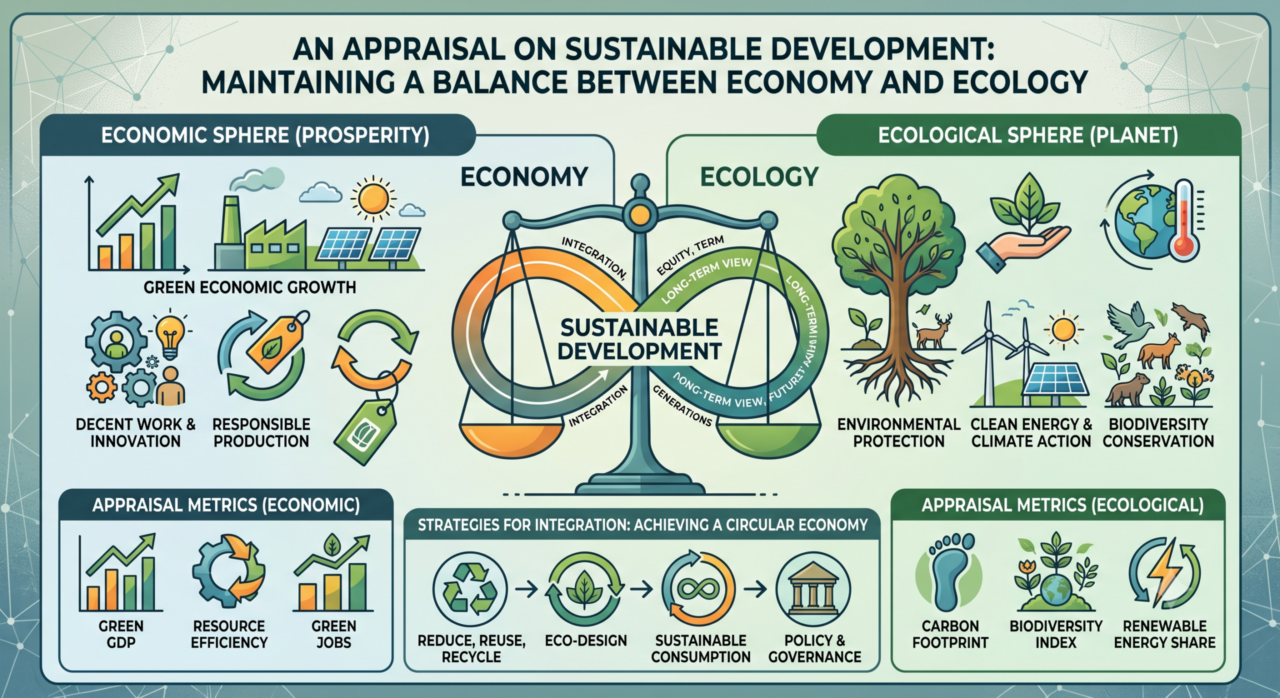
The fundamental challenge before modern societies is therefore to promote economic development without destroying ecological systems. Sustainable development attempts to address this challenge by establishing a balance between economic prosperity and environmental protection while ensuring social justice and the interests of future generations.
The concept received international recognition through the Brundtland Report, Our Common Future (1987), which described sustainable development as development that meets the needs of the present without compromising the ability of future generations to meet their own needs. This definition captures the central philosophy of sustainability: development must be both productive and responsible.
Understanding Sustainable Development:
Sustainable development is broader than environmental protection. It represents an integrated approach combining three major objectives:
Economic development – growth, employment, infrastructure, innovation, and improved standards of living;
Ecological protection – conservation of natural resources, biodiversity, forests, water, air, soil, and climate; and
Social justice – reduction of poverty and inequality and ensuring access to education, healthcare, housing, and basic necessities.
These objectives are closely interconnected. A strong economy requires natural resources, while a healthy environment requires economic resources for its protection.
Thus, sustainable development seeks to replace the traditional idea of ‘development at any cost’ with the principle of ‘development with responsibility.’
Maintaining the Balance Between Economy and Ecology:
Economic development and environmental protection are sometimes presented as conflicting objectives. Industries require land, water, minerals and energy. Infrastructure projects require natural resources. Agriculture depends upon soil and water. Urbanisation increases demand for housing, transport, electricity, and waste-management facilities.
However, economic growth that systematically destroys natural resources cannot remain sustainable. For example, uncontrolled mining may create employment and generate revenue, but it may simultaneously cause deforestation, soil erosion, groundwater contamination, biodiversity loss and displacement of communities. Similarly, rapid industrialisation can contribute to economic growth while producing air and water pollution.
Sustainable development therefore requires a middle path. Development projects should not automatically be rejected because they affect the environment, nor should environmental damage be ignored merely because a project promises economic benefits.
The correct approach is to determine whether development can be undertaken while minimising environmental harm through appropriate planning, technology, regulation, mitigation, restoration, and public participation.
Role of Judiciary, Government and Citizens:
Sustainable development requires cooperation between various institutions.
The judiciary plays an important role by enforcing constitutional rights and developing environmental principles. The legislature must create effective environmental laws. The executive must implement and enforce those laws through appropriate regulatory institutions.
Businesses must adopt cleaner technologies, reduce pollution, conserve resources and accept environmental responsibility. Citizens also have an important role under Article 51A(g) by protecting the environment and adopting responsible consumption practices.
Thus, sustainable development cannot be achieved by the courts alone. It requires institutional cooperation and public participation.
Way Forward:
India’s future development strategy should integrate environmental protection into economic planning from the beginning. Environmental impact assessment should be transparent, scientifically sound and effectively implemented. Renewable energy, sustainable transport, energy efficiency, waste management, water conservation, sustainable agriculture and biodiversity protection should be promoted.
Industries should adopt environmentally responsible technologies and internalise environmental costs. The polluter pays principle should be effectively enforced, while environmental restoration should receive appropriate attention.
Greater emphasis should also be placed on environmental education and public awareness. Citizens must understand that natural resources are finite and that individual patterns of consumption can have collective environmental consequences.
Most importantly, development policies should adopt a long-term perspective based upon intergenerational equity. Present prosperity should not be achieved by transferring environmental burdens to future generations.
Sustainable Development in the Indian Context:
The Indian Constitution provides a significant foundation for environmental protection. Article 21, through judicial interpretation, has been associated with the right to live in a healthy and pollution-free environment. Article 48A directs the State to protect and improve the environment and safeguard forests and wildlife. Article 51A(g) imposes a fundamental duty upon citizens to protect and improve the natural environment.
The Indian constitutional framework attempts to harmonise development with environmental responsibility.
Judicial Recognition of Sustainable Development:
The Indian judiciary has played a significant role in establishing sustainable development as an important principle of environmental jurisprudence.
In Vellore Citizens’ Welfare Forum v. Union of India, (1996) 5 SCC 647, the Supreme Court expressly recognised sustainable development as an essential principle for balancing environmental protection and development. The Court also recognised the precautionary principle and the polluter pays principle as important features of Indian environmental law.
In Indian Council for Enviro-Legal Action v. Union of India, (1996) 3 SCC 212, the Supreme Court applied the polluter pays principle. Industries responsible for environmental pollution could be required to bear the cost of remedial measures.
The decision reinforced the idea that economic benefits cannot be obtained by shifting environmental costs to society.
The Supreme Court’s environmental jurisprudence in the series of cases commonly associated with M. C. Mehta v. Union of India has significantly contributed to the development of environmental protection in India.
In M. C. Mehta v. Union of India, (1987) 1 SCC 395, arising from the Oleum Gas Leak, the Supreme Court developed the doctrine of absolute liability for enterprises engaged in hazardous or inherently dangerous activities. The principle imposes a high degree of responsibility upon industries whose activities pose serious risks to the community.
In M.C. Mehta v. Kamal Nath, (1997) 1 SCC 388, the Supreme Court applied the public trust doctrine. The doctrine recognises that certain natural resources are held by the State in trust for the benefit of the public and cannot be permitted to be exploited in a manner contrary to public interest.
The principle is particularly relevant to the balance between commercial development and ecological protection.
Principle of Intergenerational Equity:
A fundamental component of sustainable development is intergenerational equity. The present generation has a responsibility towards future generations.
Natural resources such as forests, rivers, minerals, groundwater, and biodiversity cannot be treated as unlimited commodities. Excessive exploitation today may deprive future generations of essential ecological and economic resources.
In State of Himachal Pradesh v. Ganesh Wood Products, (1995) 6 SCC 363, the Supreme Court emphasised ecological considerations in the context of forest-based industries. The decision illustrates the judicial recognition that short-term economic benefits cannot automatically justify long-term ecological damage.
Intergenerational equity therefore introduces a long-term perspective into developmental decision-making.
The Precautionary Principle:
The precautionary principle is particularly important where scientific knowledge about environmental risks is incomplete.
Under this principle, the absence of complete scientific certainty should not be used as a reason for postponing preventive environmental measures where there is a serious risk of environmental harm.
This principle is highly relevant to climate change, hazardous industries, genetically modified technologies, chemical pollution and other activities where environmental consequences may be irreversible.
The Polluter Pays Principle:
The polluter pays principle establishes that those who cause environmental damage should bear the financial burden of preventing and remedying that damage.
The principle has two important objectives. First, it discourages industries from treating environmental damage as an external cost. Second, it ensures that the wider public does not unfairly bear the financial consequences of private economic activities.
It therefore helps integrate environmental costs into economic decision-making.
Sustainable Development and Climate Change:
Climate change has made the balance between economy and ecology even more urgent. Traditional economic development has frequently depended upon fossil fuels and resource-intensive production. However, continued dependence upon carbon-intensive activities contributes to greenhouse gas emissions and global warming.
The transition towards a sustainable economy requires:
- Renewable energy;
- Energy efficiency;
- Sustainable transport;
- Climate-resilient infrastructure;
- Sustainable agriculture;
- Responsible industrial production;
- Forest conservation; and
- Reduction and recycling of waste.
Sustainable Development and Social Justice:
Sustainable development cannot be reduced to a simple conflict between industries and forests. Environmental decisions often have significant consequences for local communities.
Large infrastructure, mining, industrial and development projects may provide employment and economic opportunities but can also result in displacement or loss of traditional livelihoods.
Therefore, sustainable development requires participatory decision-making, transparency, rehabilitation, compensation and protection of vulnerable communities.
Environmental justice requires that environmental benefits and burdens be distributed fairly. A development model cannot be sustainable if economic benefits are privatised while environmental costs are imposed upon poorer sections of society.
Role of Business and Industry:
Industries have an important role in achieving the balance between economy and ecology. Businesses can adopt cleaner technologies, renewable energy, resource-efficient production methods, waste reduction, water conservation, and responsible supply chains.
The idea of corporate environmental responsibility is increasingly important because environmental protection cannot be achieved solely through government regulation.
Businesses should recognise that environmental sustainability can also create long-term economic advantages. Energy efficiency can reduce costs, renewable energy can improve resilience, sustainable production can reduce waste and environmentally responsible practices can strengthen public confidence.
Challenges to Sustainable Development:
Despite its importance, sustainable development faces several challenges:
1. Conflict between Short-Term and Long-Term Interests
Governments and businesses may prioritise immediate economic benefits over long-term environmental consequences.
2. Poverty and Inequality
Poor communities often depend directly upon natural resources for their livelihood. Environmental policies must therefore be designed in a manner that does not disproportionately burden vulnerable populations.
3. Weak Enforcement
India has a substantial body of environmental legislation, but effective implementation and enforcement remain crucial challenges.
4. Population and Urbanisation Pressure
Rapid urbanisation increases demand for housing, transport, electricity, water, and waste-management infrastructure.
5. Climate Change
Climate change creates new risks for agriculture, water resources, coastal communities, biodiversity and public infrastructure.
6. Unsustainable Consumption
Growing consumption of energy, plastics, minerals and other resources can place substantial pressure on ecological systems.
An Appraisal: Is the Balance Possible?
The central question is whether economic growth and environmental protection are genuinely compatible.
The answer should be yes, but only if the nature of development changes.
Economic development cannot continue indefinitely on the assumption that natural resources are unlimited. At the same time, environmental protection cannot ignore the legitimate developmental needs of millions of people.
The appropriate approach is therefore not economy versus ecology, but economy with ecology.
Sustainable development requires environmental costs to be incorporated into economic decisions. Development projects should consider ecological impacts before approval. Industries should adopt cleaner production methods. Governments should promote renewable energy and sustainable infrastructure. Citizens should adopt responsible patterns of consumption.
The goal should be to create an economy in which environmental protection is not viewed as an obstacle to development but as a foundation for durable development.
Conclusion of The blog Maintaining Balance Between Economy and Ecology
Sustainable development represents a fundamental shift in the understanding of progress. Economic growth is necessary for improving human welfare, but growth that destroys ecological foundations cannot remain sustainable. Similarly, environmental protection must take account of the developmental needs of society.
The Indian constitutional framework and judicial decisions have contributed significantly for creating a legal and philosophical balance between development and environmental protection. The recognition of sustainable development, precautionary principle, polluter pays principle, public trust doctrine and intergenerational equity demonstrates the importance of integrating ecological considerations into economic decision-making.
The ultimate objective should therefore be “development without destruction.” A truly sustainable economy is one that generates prosperity while preserving the ecological systems upon which human life and economic activity depend.
Sustainable development is consequently not a choice between economy and ecology. It is an effort to ensure that economic prosperity, social justice, and ecological security progress together. The real measure of development should not simply be how much a society produces today, but whether it can continue to prosper tomorrow without exhausting the natural foundations of life. We have to remember that ‘We have only one Earth to live’. So, we have to give importance on Sustainable Development and we have to maintain a balance between Economy and Ecology.
MIES R M Law College, Sonarpur, South Kolkata, contribute significantly to this mission by nurturing future legal professionals who are equipped to address issues of education, social justice, and public policy. As a Bar Council of India–approved law college affiliated with Vidyasagar University, the institution emphasizes both academic excellence and practical exposure, preparing students for careers in law, governance, and advocacy. By fostering awareness and critical understanding of fundamental rights like education, MIES R M Law College plays a vital role in shaping a more just, informed, and inclusive society.
_ . _