RESERVATION QUOTAS IN THE RECRUITMENT POLICY OF THE GOVT. IN INDIA
An Insightful article on “Reservation quotas in the recruitment policy of the Govt.in India” has been authored by Mr. Tapan Kumar Das in association with Mr. Soumik Ash, who is associated with MIES RM Law College for last 5 years as a Skill Development Officer. Which is one of the best Law College in West Bengal. In His opinion MIES RM Law College is one of the top Law College in West Bengal.
As a Bar Council of India–approved institution affiliated with Vidyasagar University, the college offers quality legal education in India, supported by an active placement cell, regular internship opportunities, and a well-equipped campus with modern facilities that enhance both academic and professional growth.
RESERVATION QUOTAS IN THE RECRUITMENT POLICY OF THE GOVT. IN INDIA
1. INTRODUCTION OF RESERVATION QUOTAS IN THE RECRUITMENT POLICY OF THE GOVT. IN INDIA
Recruitment Policy in Indian Government Services is a structured framework designed to ensure fair, transparent and merit-based hiring to fill public sector positions. It emphasizes impartiality, adherence to constitutional provisions such as Reservation Quotas and filling roles through standardized methods like competitive examinations and interviewer conducted by Independent Bodies.
2. KEY ASPECTS OF RECRUITMENT POLICY IN INDIA.
a) Constitutional Methods.
There are governed by Article 309 of the Indian constitution, which, in the absence of legislative action empowers the Precedent or Governors to create temporary rules for public service employments.
b) Merit-Based and Independent
Aims to hire skilled talent through impartial agencies like Union Public service commission (UPSC) for Central Services & state public service commissions (SPSCs) for state roles.
c) Reservation & Social Justice.
Government incorporates mandatory reservations for scheduled casts (SC), Scheduled Tribes (ST), other backward classes (OBC) and economically weaker Sections (EWS) to ensure equitable representation.
d) Transparency and uniformity.
Government follows strict, predetermined Recruitment Rules (RR) for every position, outlining qualifications, age limits & selection methods.
3. PRIMARY METHODS OF RECRUITMENT
a) Direct Recruitment:
The most common methods involving open competitive examination e.g. Civil Service Exam and interviews conducted by commissions.
b) Promotion:
This is the way of filling higher posts/positions by promoting qualified employees from lower ranks, ensuring a career progression ladder.
c) Deputation / Transfer.
These transferring personnel from other government Departments, State Governments or Autonomous Bodies for a temporary period.
d) Special Selection / Lateral Entry
This relates to recruiting specialized talent from the private sector or academia for specific high-level positions, through this is less frequent than traditional methods.
4. Govt. Tribal quota details are as follows
Thetribal quota (for scheduled Tribes or STs in Govt. of India jobs is 7.5%. This fixed percentage reservations as significantly lower than their overall share of the country’s population, as STs make up about 8.6% of India’s total population (according to 2011 census)
Alike Tribal quota STs are also allowed standard 7.5% quota in all open competition/ direct recruitment across national civil services and central educational institutions. In case of promotion to STs are entitled to this 7.5% quota/ reservation in jobs.
Why the difference is there in term of Tribal quota and the STs Quota.?
The 7.5% reservation was originally calculated based on early population when the constitution of India was drafted. Despite the Tribal population, growing to over 8.6% of the nation’s total demographics and Supreme Court copping total reservations across all categories at 50%, the national STs job quota has remained at 7.5%.
Age relaxation in recruitment rules/ policy in the govt. jobs
Age relaxation is a policy that allows specific groups (SC/ST, OBC or PWD) to apply for govt. or corporate jobs beyond the standard upper-age limit. It adds extra to promote equal opportunity and account for systemic or historical disadvantages usually minimum & maximum age limit for unreserved category is 18 to 27 years. But in few exams like Bank PO, RRB NTPC etc the maximum age limit is 30 to 33 years. Govt. of West Bengal had already been announced 5 years extension of maximum age limit for any Govt. job exams conducted under State Govt.
However the standard age relaxation rules are usually cumulative. For example, in govt. jobs exams- such as OBC candidate get + 3 years, SC/ST get + 5 years and PWD applicants get + 10 years added to the base maximum age.
5. KEY RECRUITMENT BODIES
a) UPSC (Union Public Service Commission)
It handles recruitment for Group-A and some Group-B (non gazette) and Group-C for posts in Ministries and Departments.
b) SSC (Staff Selection Commission)
It handles recruitment for Group B (non-gazette) and Group-C for posts in Ministers / Departments.
c) State PSCs
It conducts recruitment for State-level civil services.
6. EVEN AFTER 79 YEARS OF THE COUNTRY’S FREEDOM (IN 1947), THE RESERVATION QUOTAS LIKE SC, ST, OBC & EWS IN REGARD TO EMPLOYMENT / RECRUITMENT POLICY OF THE GOVERNMENT, SHOULD IT REMAIN MANDATORY INEVITABLE.
The Indian Govt. thinks that Reservation quotas policy is still relevant in India as it has been functioning as a system of affirmative action to ensure social justice, equality, and representation. They are designed to address historical injustices, cast-based exclusion and social disadvantages by reserving a specific percentage of seats and posts in public employment. This system of employment or recruitment rules & policies cannot be ignored due to complexities, diversities, variances that still exist in Indian Social System, historically, from since evolving its civilization.
7. AS OF 2026, THE PRESENT STAGE & SITUATION OF THE GOVERNMENT RECRUITMENT FRAMEWORK.
The government as has justified and honored the constitutional mandate as the recruitment policy is legally mandated under Articles 15 (4) and 16 (4) of the Indian constitution, allowing special provisions for the advancement of backward classes.
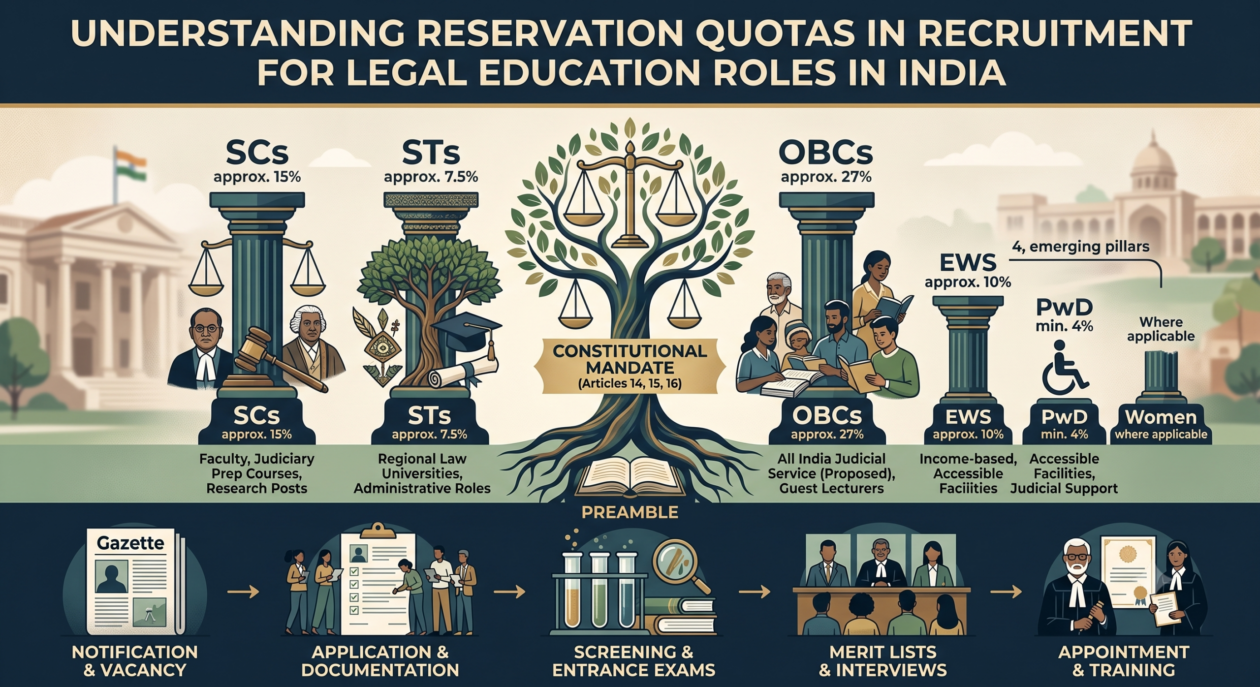
As of early 2026, the central government recruitment framework maintains a structured quota system of SC, ST, OBC and EWS candidates, with vertical reservations generally gapped around 50% for SC/ST/OBC combined, plus a 10% EWS quota, alongside horizontal reservations for PWD and Women.
8. KEY ASPECTS OF RESERVATION QUOTAS OF 2026
These are based on caste categories, in central government, the standard quotas are typically 15% for Scheduled Castes(SC), 7.5% for Scheduled Tribes(ST), 27% for other backward Classes (OBC – Non-Creamy layer), and 10% for Economically weaker Sections (EWS ). The 10% for EWS reservation does not cut into 50% quota reserved for SC,ST, and OBC candidates. Instead it was introduced as an additional 10% allocation specially for the unreserved (general) category, taking total reservation up to 60% in govt jobs & educational institution.
These cut across vertical categories, providing special provisions for women, persons with disabilities (PWD – 4% quota), and ex-serviceman, as per the Rights of
The primary aim is to rectify historical inequities, ensure adequate representation and promote social justice (as per Articles 15 and 16 of the constitution).
These quotas are widely applied to direct recruitments made through the Union Public Service Commission (UPSC), SSC and other Central/ State public sector entities.
9. RELEVANCE IN RECRUITMENT POLICY
Reservations acts as a proactive measure to help communities historically deprived of education and resources complete fairly with more advantaged sections.
It ensures that Govt. services are not dominated by any single section, promoting diversity6 within Public Employment.
The policy is legally mandated under Articles 15 (4) and 16 (4) of Indian constitution, allowing special provisions for the advancement of backward class in the country.
Candidates belonging to reserved categories received relaxations in Age limits and application fees, expanding access to government jobs.
10. CURRENT CHALLENGES AND NUANCES
The 50% limit, while the Supreme Court initially uphold 50% cap on total reservation, the 103rd Amendment (EWS) technically allows for a higher percentage, leading to ongoing legal discussion.
The Creamy layer criterion applies to OBC, excluding wealthier individuals from benefits, while this does not apply to SC/ST categories.
A significant issue is that some reserved posts often remain unfilled due to lack of eligible candidates.
11. COMMENT OF THE NEUTRALLY OVERVIEWED SOURCE.
The Reservation system, therefore, is not merely a job allotment system, but a broads mechanism intended to faster more inclusive society and democrative governance.
12. IS INDIA, AN EXCEPTION IN THE WORLD AS REGARDS RECRUITMENT POLICY BY AS QUOTA BASED PERCENTAGE?
No other democratic country in the world has a constitutional recruitment policy as extensive as India’s as an ideally exception.
However, many democracies use “Affirmative Action” or targeted quota policies in their civil services to ensure fair representation of historically marginalized groups.
13. A FEW OTHER COUNTRIES MORE OR LESS WITH SIMILAR QUOTA POLICIES
The country’s constitution guarantees a quota system in government jobs & education to empower marginalized communities, including Dalits, Indigenous people & Madhesis.
Post—apartheid, the government instituted employment equity and affirmative action policies to increase the representation of black people, women and individuals with disabilities in the public sector.
The employment equity Act ensures that underrepresented groups specifically indigenous peoples, visible minorities and women have equitable representation in the federal public service.
The government uses structured quotas and economic policies designed to empower, disadvantaged groups, notably the Bumiputera majority, without public service.
Moreover, The country operates under a structural quota system designed to ensure that minority group, notably ethnic Albanians, are fairly represented in civil Assia.
14. Demerits of Indian Govt’s recruitments policy
The demerits of a government’s recruitment policy refer to the drawbacks, flows and negative consequences of the rules, process & criteria, an administration uses to hire public sector employees. Nevertheless, these issues often prevent the Government from relating the most highly qualified candidates.
Common flows and disadvantages, in public sector hiring included:-
a) Inefficiency and exclusive Bureaucracy.
Government recruitment often requires navigating massive administrative layers, leading to living cycles that can take months or even years.
Delayed vacancies frequently remain empty for long periods due to also bureaucratic approval and frequented oversight.
b) Lack of flexibility and meritocracy seniority over ability.
Promotions and placements often heavily prioritize seniority (years of service) rather than actual performance, talent or merit. Recruitment rules can be outdated and valuing formal academic degrees over practical, modern skill sets.
c) Susceptibility to external influence
The hiring process is sometimes vulnerable to favoritism, nepotism, or political agendas, which undermines principle of fair and open competition. Complex or opaque systems corruption can create opportunities for bribery, leaked exam papers or systemic bias.
d) Limited Lateral Mobility:
Many Government policies focus exclusively on entry-level hiring and internal promotions. This discourages talented professionals from that private sector or academic from internship Govt. at mid to senior levels.
Conclusive remarks & criticism of the recruitment policy.
There are conclusive remarks against the recruitment policy of Indian Government which means definitive criticisms or final judgments concluding that the States hiring framework is flawed, discriminatory or inefficient. Moreover, these remarks often emerge in judicial verdicts, parliamentary committee reports, or public policy reviews.
Depending on the context, these remarks typically point to a few specific criticism.
a) Judicial Rulings: The Supreme Court of India occasionally passes remarks or arbitrary changes to recruitment rules, changing eligibility criteria mid-process, or lack of transparency. Such remarks mean the hiring process violets Article 14 and 16 of the constitution, which guaranties equality of opportunity in public c employment.
b) Absolute Scrupulousness: Judicial Bodies emphasize that the Government hold a public duty to ensure absolutely fair recruitment to maintain public trust, therefore, leaving no room for foul play or negligence
Briefly Employees’ promotion policy of the Govt. India.
Government employees promotions are governed by structured guidelines emphasizing merit, seniority and benchmark performance.
Key rules at a glance.
a) Promotion are generally based on either merit-cum-seniority ( merit is the primary factor) or seniority-cum-fitness(seniority prevails, provided the employee meets minimum fitness and qualification standards).
b) Eligibility requires consistently good. Annual performance Assessment Reports(APARs) and a clean vigilance/disciplinary record.
c) Employees must complete mandatory minimum residency period in their current grade or rank before being considered for the next level.
d) Promotions are typically vetted by a Departments Committee (DPC) which reviews service records to ensure all criteria are met.
CONCLUSION OF RESERVATION QUOTAS IN THE RECRUITMENT POLICY OF THE GOVT. IN INDIA
So far viewed and overviewed it seems India’s policy of recruitment is a unique one, unlike general affirmative action policies used in countries like the United States and United Kingdom.
It is only India’s recruitment policy mandatory fixed percentages of reservation in govt. jobs and educational institutions for specifically identified groups like SC, ST, and OBC & Other Backward classes being it an ideally modeled country of diversities.
MIES R M Law College, Sonarpur, South Kolkata, contribute significantly to this mission by nurturing future legal professionals who are equipped to address issues of education, social justice, and public policy. As a Bar Council of India–approved law college affiliated with Vidyasagar University, the institution emphasizes both academic excellence and practical exposure, preparing students for careers in law, governance, and advocacy. By fostering awareness and critical understanding of fundamental rights like education, MIES R M Law College plays a vital role in shaping a more just, informed, and inclusive society.
___________