ADR as Living Justice Issues and Challenges in India
The blog “ADR as Living Justice Issues and Challenges in India” is written by Mr Soumik Ash, Asst Prof of MIES R M Law College and Sumana Sanyal, student of 6th Semester under the guidance of Dr Dibyendu Kr Banerjee, Principal of MIES R.M. Law College affiliated to Vidyasagar University.
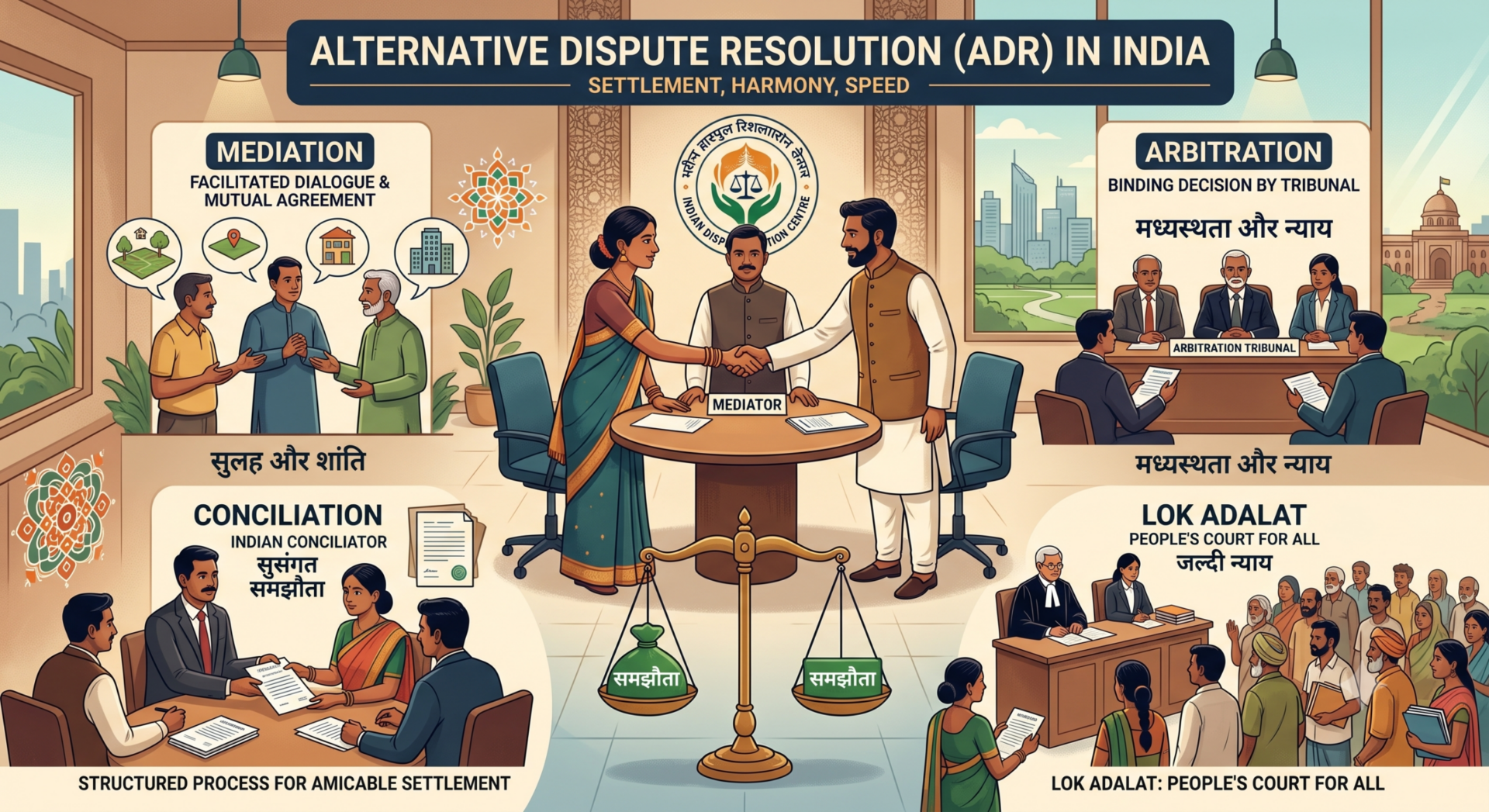
Alternative Dispute Resolution (ADR) has emerged as an important component of the Indian justice-delivery system. It includes arbitration, mediation, conciliation, negotiation and Lok Adalat. ADR is often described as “living justice” because it seeks to make justice practical, accessible, participatory, speedy and responsive to the actual needs of disputing parties rather than confining them to prolonged adversarial litigation.
At MIES R M Law College, Sonarpur, South Kolkata—one of the leading law colleges in West Bengal—students gain in-depth knowledge of constitutional rights and social justice through its 3-year law program. As a Bar Council of India–approved institution affiliated with Vidyasagar University, the college offers quality legal education in India, supported by an active placement cell, regular internship opportunities, and a well-equipped campus with modern facilities that enhance both academic and professional growth.
Introduction to ADR as Living Justice Issues and Challenges in India
Justice is fundamental to a respectful society and has been a long-standing ideal for humanity. The Preamble of the Constitution reflects this commitment to justice through its emphasis on social, economic, and political dimensions. Article 39-A specifically ensures equal access to justice, highlighting the importance of protecting the innocent, punishing the guilty, and resolving disputes effectively. However, traditional adversarial litigation faces significant challenges, including overcrowded courtrooms, limited resources, and procedural delays, which underscore the need for more efficient methods of conflict resolution. In this context, Alternative Dispute Resolution (ADR) mechanisms emerge as a practical solution, offering viable pathways to address these issues and enhance the administration of justice.
Concept of Alternative Dispute Resolution system
Alternative Dispute Resolution (ADR) has historical significance, tracing back to ancient India where conflicts were resolved through community-based mechanisms such as Kulas, Srenis, and Parishads. These traditional practices highlight the longstanding human inclination towards amicable conflict resolution. The contemporary ADR movement aims to enhance the efficiency of dispute resolution by minimizing frustration, reducing costs, and decreasing delays. Furthermore, it emphasizes the fundamental principle of ensuring access to justice for all individuals, reflecting a commitment to equitable legal processes.
The ADR system aims to deliver affordable, straightforward, swift, and accessible justice. It is a process that differs from the conventional judicial system. In this framework, disputes are resolved with the help of a third party, and the proceedings are generally conducted in a manner agreed upon by the involved parties.
ADR encourages the prompt resolution of disputes with minimal expenditure of time, resources, and finances, focusing on achieving substantial justice while preserving the confidentiality of the matters at hand.
Mechanisms of ADR in respect to ADR as Living Justice Issues
- Arbitration
- Mediation
- Conciliation
- Negotiation
- Lok Adalat
Function of ADR
1. ADR is not intended to completely replace the traditional legal system. Rather, it provides an alternative option for the parties involved in litigation.
2. ADR resolves disputes in a neutral and amicable manner.
3. ADR is regarded as a crucial component of judicial reform, embodying the “access to justice approach.”
4. The main purpose of ADR is to address the root causes of issues and eliminate them, rather than merely treating their symptoms. This approach aims for a more effective and enduring solution.
5. ADR can be perceived as a compromise in which no party loses or wins, allowing everyone to emerge as a winner.
Striving to better Justice through ADR
It has been aptly stated that: ‘An effective judicial system necessitates not only the attainment of just outcomes but also the promptness of these outcomes.’ However, the existing court infrastructure in India is insufficient to address the increasing volume of litigation within a reasonable timeframe. Despite ongoing efforts, an ordinary individual may occasionally find himself ensnared in legal disputes for an entire lifetime, and in some instances, litigation may extend to subsequent generations. In this process, he may deplete his resources while also enduring harassment. Consequently, there is a cascading effect of the litigation process, where civil cases can even lead to criminal cases. The swift resolution of cases and the provision of quality justice remain a persistent priority for all stakeholders involved in the administration of justice.
In this regard, there is an urgent necessity to enhance the current court infrastructure through the implementation of Alternative Dispute Resolution (ADR) mechanisms. In addition to improving the efficiency of the judiciary, initiatives are being undertaken globally to utilize ADR systems for resolving outstanding disputes as well as at the pre-litigation phase. Efforts directed towards ADR have achieved significant success and favourable outcomes in various parts of the world, particularly in the litigation-intensive United States, where professional teams of mediators and conciliators have effectively augmented the dispute resolution and adjudication processes.
Challenges of the Formal Legal System:
Awareness: A significant obstacle to accessing the formal legal system is the widespread lack of awareness regarding legal rights and remedies among the general populace.
Mystification: The legal language, often characterized by complex and difficult English, renders it incomprehensible even to educated individuals. There have been few efforts to translate the language of the law into vernacular forms, making it simpler and more understandable for the average person.
Delays: One of the most pressing issues confronting the justice delivery system today is the protracted delays in case resolution and the exorbitant costs associated with litigation. Alternative dispute resolution was conceived as a potential solution to this problem. The average waiting period in both civil and criminal subordinate courts can extend to several years, undermining the principle of fair justice. Numerous obstacles contribute to this situation. The Indian judiciary is already grappling with a backlog crisis. As of October 31, 2005, the Supreme Court had a staggering 253,587,003 pending cases. This immense backlog further diminishes the accessibility of justice. The delays within the judicial system erode public confidence in the very concept of justice.
Expenses and Costs: It is widely recognized that our cost regime is ineffective; even successful litigants often struggle to recover the actual expenses incurred during litigation. The significant delays in reaching a resolution in any legal matter exacerbate these costs and highlight the absence of an effective mechanism for their recovery.
ADR mechanisms in Indian Law & Judiciary
At one time, Alternative Dispute Resolution (ADR) was regarded as a voluntary action by the parties involved, which has since received statutory acknowledgment through the CPC Amendment Act of 1999, the Arbitration and Conciliation Act of 1996, the Legal Services Authorities Act of 1997, and the Legal Services Authorities (Amendment) Act of 2002. The Parliament, alongside litigants, the general public, and statutory bodies such as the Legal Services Authority, has now placed the responsibility on the judiciary. Consequently, what is now necessary is the implementation of the objectives set forth by Parliament.
Access to justice is recognized as a human right, and the right to a fair trial is also a fundamental human right. In several nations, the right to a trial within a reasonable timeframe is enshrined in human rights legislation. However, in our country, this is a constitutional duty as outlined in Articles 14 and 21. Therefore, the use of ADR as a means to ensure access to justice should be viewed as a human rights issue. In this regard, the judiciary will have a significant role to play.
Before the enactment of Section 89 of the Civil Procedure Code (CPC), various legal provisions allowed courts to refer disputes to mediation, yet these provisions were not effectively utilized. Such provisions are present in the Industrial Disputes Act, the Hindu Marriage Act, and the Family Courts Act, as well as in a more basic form through Section 80, Order 32 A, and Rule 5 B of Order 27 of the CPC. This lack of effective use is further illustrated in the judicial decisions of ONGC Vs. Western Co. of Northern America and ONGC Vs. Saw Pipes Ltd. (2003) 5 SCC 705, which highlight the challenges in implementing mediation prior to the introduction of Section 89.
The Industrial Disputes Act of 1947 establishes provisions for both conciliation and arbitration aimed at resolving disputes.
According to Section 23(2) of the Hindu Marriage Act, 1955, it is the court’s obligation to first attempt to facilitate a reconciliation between the parties before providing any relief under this Act, provided that such reconciliation is feasible given the nature and circumstances of the case.
To facilitate reconciliation, the Court may postpone the proceedings for a reasonable duration and assign the matter to an individual designated by the court or the parties involved, instructing them to report back to the court regarding the outcome of the reconciliation.
The Family Court Act of 1984 was established to create Family Courts aimed at fostering conciliation and ensuring the prompt resolution of disputes concerning marriage and family matters, employing a fundamentally different approach from standard civil proceedings. as held in K. A. Abdul Jalees v. T. A. Sahida (2003) 4 SCC 166. Section 9 of the Family Courts Act, 1984 outlines the responsibility of the Family Court to aid and encourage the parties, initially, in reaching a settlement regarding the subject matter.
The Family Court has been granted the authority to postpone proceedings for a reasonable duration to allow for attempts at reaching a settlement, provided there is a plausible chance of success.
Section 80 (1) of the Code of Civil Procedure, 1908 stipulates that no legal action may be initiated against the government or a public officer unless a notice has been served at the government office, detailing the cause of action, the name of the claimant, and other relevant information.
In Ghanshyam Dass v. Domination of India, (1984) 3 SCC 46, Supreme Court says that the purpose of Section 80 of the Code of Civil Procedure, 1908 is to provide the government with adequate notice of the impending legal action, allowing it the opportunity to resolve the matter without resorting to litigation or to provide restitution without the need for court intervention. In Raghunath Das v. UOI AIR 1969 SC 674 the intent of Section 80 is to afford the government the chance to evaluate its legal standing and, if deemed appropriate, to rectify the situation or settle the claim amicably outside of court.
Conclusion of ADR as Living Justice Issues
ADR is faster, more cost-effective, and more accessible than traditional courts. It allows individuals to engage in the dispute resolution process in a manner that is not achievable within the public, formal, and adversarial justice system, which is often seen as dominated by complex procedures and obscure legal terminology. ADR provides options: options regarding methods, procedures, costs, representation, and locations. Since it is frequently quicker than court proceedings, it can alleviate the burden on the courts. Additionally, its cost-effectiveness can help mitigate the rising trend of legal expenses and legal aid costs, benefiting both the parties involved and taxpayers.
At this point, several actions are essential to enhance the smooth functioning of ADR mechanisms. The first step is to raise awareness and promote these methods, with NGOs and media playing a crucial role in this effort.
For court-annexed mediation and conciliation, it is imperative to have the necessary personnel and infrastructure, which will require government funding.
Training programs focused on ADR mechanisms as ADR as Living Justice Issues are critically important. State-level judicial academies can take on the role of facilitators or active participants in this initiative.
While the courts have consistently endeavored to provide access to justice for the vast population of this country, it is fair to assert that achieving this goal is unattainable without reforming the justice delivery system. Such reform can be pursued in two ways: through structural changes and operational changes. Structural changes challenge the very framework of the system and necessitate an evaluation of the feasibility of alternative justice delivery frameworks. This may require amendments to the Constitution or various statutes. Conversely, operational changes involve working within the existing framework to identify various methods for enhancing the effectiveness of the legal system.
It goes without saying that this will significantly alleviate the burden on the courts while also offering immediate justice at one’s doorstep, without incurring substantial costs. Furthermore, this approach will circumvent procedural technicalities and delays, with the hope that justice will be grounded in truth and morality, in line with recognized principles of delivering social justice.
The discussion in this blog will raise definitely a lot of question and query. And we are hopeful that readers will work on those queries and share their opinion.
MIES R M Law College, Sonarpur, South Kolkata, contribute significantly to this mission by nurturing future legal professionals who are equipped to address issues of education, social justice, and public policy. As a Bar Council of India–approved law college affiliated with Vidyasagar University, the institution emphasizes both academic excellence and practical exposure, preparing students for careers in law, governance, and advocacy. By fostering awareness and critical understanding of fundamental rights like education, MIES R M Law College plays a vital role in shaping a more just, informed, and inclusive society.
ADR as Living Justice Issues and Challenges in India
Guided by
By
Soumik Ash, Assistant Professor, MIES R M Law College, Vidyasagar University
&
Sumana Sanyal, Student, 6th Semester, MIES R M Law College, Vidyasagar University
Prof (Dr.) Dibyendu Kumar Banerjee, Principal, MIES R M Law College, Vidyasagar University