Indian Constitution and Tribal Rights
The blog “Indian Constitution and Tribal Rights is written by Mr. Soumik Ash, Assistant Professor of MIES R.M. Law College, affiliated to Vidyasagar University, and Malini Bose, a student of the 2nd Semester of MIES R M Law College, affiliated to Vidyasagar University, and approved by the Bar Council of India. The Constitution of India provides special protections and rights for cohort communities, officially called STs. These provisions aim to protect tribal identity, land, culture, education, and political representation while promoting social and economic development.
At MIES R M Law College, Sonarpur, South Kolkata—one of the leading law colleges in West Bengal—students gain in-depth knowledge of constitutional rights and social justice through its 3-year law program. As a Bar Council of India–approved institution affiliated with Vidyasagar University, the college offers quality legal education in India, supported by an active placement cell, regular internship opportunities, and a well-equipped campus with modern facilities that enhance both academic and professional growth.
Indian Constitution and Tribal Rights By Soumik Ash, Assistant Professor, MIES R M Law College, Vidyasagar University & Malini Bose, Student, 1st Year, MIES R M Law College, Vidyasagar University
Indian Constitution and Tribal Rights
Introduction: Indian Constitution and Tribal Rights
The concept of ‘tribal’ in the Indian Constitution is formulated within the framework of Hindu caste stratification for administrative purposes. Individuals identified as tribals are social groups who are not obligated to the Hindu caste system, yet are perceived as belonging to the same category as the outcastes within the Hindu caste system. In other words, tribals are regarded as non-Hindu outcastes. Therefore, the constitutional definition of ‘tribal’ remains ambiguous.
Article 342 of the Indian Constitution and Tribal Rights
(1) The President may, with respect to any State or Union territory, and where it is a State, after consultation with the Governor thereof, by public notification, specify the cohorts or cohort communities or parts of or groups within cohorts or cohort communities which shall, for this Constitution, be deemed to be ST in relation to that State or Union Territory, as the case may be.
(2) Parliament may, by law, include in or exclude from the list of ST specified in a notification issued under clause (1) any cohort or cohort community or part of or group within any cohort or cohort community, but save as aforesaid, a notification under the said clause shall not be varied by any subsequent notification.
Due to the ambiguous nature of cohort identity, the population figures for cohorts in the Indian census have fluctuated unpredictably. For instance, in 1931, the population was recorded at 22 million; in 1941, it dropped to 10 million; in 1961, it rose to approximately 30 million; in 1991, it reached nearly 68 million; and by 2001, it was around 84 million. The tribal population accounts for about 8.6% (approx) of the total Indian population. Accurately determining the number of tribal communities in India is also quite challenging, as the list of these communities is continually evolving.
Additionally, many cohorts are registered across three or more states, and some cohorts on the list may actually be classified as sub-cohorts within a larger cohort. Although the constitutional definition of tribal identity is quite vague, tribals are generally perceived as a homogeneous group that does not belong to either Hindu or Muslim communities, often facing economic hardship and social marginalization. They are regarded as marginalized groups and classified as backward classes.
Rights of Tribals in The Indian Constitution
The architects of the Constitution recognized that some communities within the nation were enduring significant social, educational, and economic disadvantages due to the long-standing practice of untouchability. Additionally, other communities faced challenges stemming from outdated agricultural methods, insufficient infrastructure, and geographical isolation. These groups require special attention to protect their interests and to promote their rapid socio-economic advancement.
In order to establish protections against the exploitation of SC and ST, as well as to advance and safeguard their social, educational, economic, and cultural interests, specific provisions were incorporated into the Constitution. Given their social disadvantages and economic challenges, these groups faced significant obstacles in obtaining a fair representation in elected positions, government employment, and educational institutions. Consequently, it was deemed essential to implement a policy of reservations in their favor to guarantee their fair involvement in governance.
Article 46 (Directive Principles of State Policy) represents a thorough provision that encompasses both developmental and regulatory dimensions. It states that “The State shall promote with special care the educational and economic interests of the weaker sections of the people, particularly those belonging to the SC and ST, and shall safeguard them from social injustice and all forms of exploitation.” In light of these enabling provisions, various safeguards have been established for the socio-economic and educational advancement of SC and ST within the Constitution of India. Let us highlight some significant constitutional provisions about cohorts.
Safeguard of the Society for Tribal People
Article 23 prohibits traffic in human beings and beggar and other similar forms of forced labour and provides that any contravention of this provision shall be an offence punishable in accordance with law. It does not specifically mention ST, but since the majority of bonded labour belongs to ST, this Article has a special significance for members of ST. In pursuance of this Article, Parliament has enacted the Bonded Labour System (Abolition) Act, 1976. For the effective implementation of this Act, the Ministry of Labour is running a Centrally Sponsored Scheme for the identification, liberation, and rehabilitation of bonded labour.
Economic Safeguards for SC, ST
The stipulations outlined in Articles 23, 24, and 46 referenced above also constitute components of the economic protections for ST as well as for SC. The particular protections designated for the ST are detailed below:
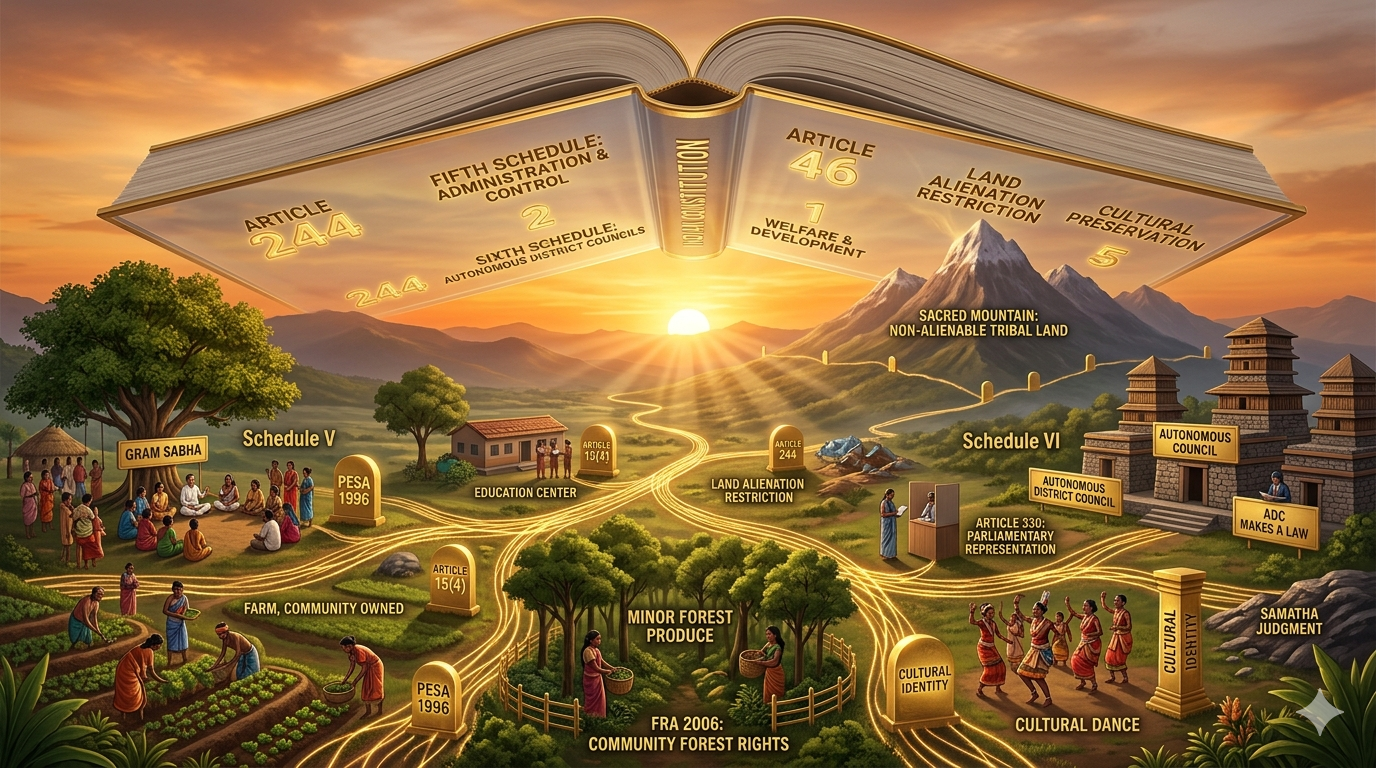
Article 244: According to clause (1), the provisions of the Fifth Schedule shall apply to the administration and control of the Scheduled Areas and ST in any State other than the States of Assam, Meghalaya, Mizoram, and Tripura. According to Clause (2), the provisions of the Sixth Schedule shall apply to the administration of the tribal areas in the States of Assam, Meghalaya, Mizoram, and Tripura.
The First Provision to Article 275 (1) of the Constitution of India guarantees grants from the Consolidated Fund of India each year for promoting the welfare of Meghalaya, Mizoram, and Tripura. And in pursuance of this Constitutional obligation, the Ministry of Tribal Affairs provides funds through the Central Sector Scheme ―Grants under Article 275 (1) of the Constitution. The objective of the scheme is to meet the cost of such projects for tribal development, which may be undertaken by the State Governments, for raising the level of administration of the Scheduled areas therein to that of the rest of the State.
The scheme covers all 21 Tribal Sub-Plan States and 4 other tribal majority States of the country. The grants are to be used essentially for the creation and upgradation of critical infrastructure required to bring the tribal areas up to date with the rest of the country. The basic purpose is to create opportunities conducive to income and employment generation. Due emphasis is given to infrastructure in sectors critical to the enhancement of human development indices, such as health, education, income generation, etc.
The Fifth Schedule
The Fifth Schedule outlines the regulations concerning the administration and oversight of the Scheduled Areas and ST There are nine States that include Scheduled Areas, namely Andhra Pradesh, Gujarat, Himachal Pradesh, Madhya Pradesh, Maharashtra, Odisha, Rajasthan, Chhattisgarh, and Jharkhand. The Governors of these States hold specific responsibilities and authorities. Additionally, these States have Tribe Advisory Councils (TACs). (Furthermore, Tamil Nadu and West Bengal, despite lacking Scheduled Areas, also possess statutory TACs). The Governors of these States are empowered to establish regulations aimed at ensuring peace and effective governance within any Scheduled Area, particularly for the following objectives: –
(a) To prohibit or limit the transfer of land by or between members of the ST in these areas,
(b) To oversee the allocation of land to members of the ST in these areas,
(c) To regulate the operations of individuals acting as money lenders to members of the ST in these areas.
The Sixth Schedule
The Sixth Schedule encompasses provisions concerning the governance of the Tribal Areas located in the States of Assam (specifically the North Cachar Hill District and Karbi Anglong District), Meghalaya, Mizoram, and Tripura (which includes the Autonomous Hill District). Within these regions, there exist Autonomous District Councils and Autonomous Regional Councils that uphold a longstanding tradition of self-governance. These Autonomous Councils are responsible not only for managing various Departments and developmental initiatives but also possess the authority to legislate on a wide range of topics, such as land, forestry, shifting agriculture, local administration (including village or town police), public health and sanitation, property inheritance, marriage and divorce, as well as social customs.
Constitutional Provisions for the SC, including Reservation
Women from SCs and STs are specifically mentioned and protected in several provisions of the Constitution of India, mainly through special‑reservation and equality‑plus provisions.
Article 15(4) and 15(5) expressly allow the State to make special provisions for “socially and educationally backward classes” and for SC and ST, which courts have interpreted as permitting affirmative‑action schemes that can also benefit SC/ST women. Women‑specific “special provisions” Article 15(3) empowers the State to make “special provisions for women and children,” which has been used to justify laws and schemes for women, including SC/ST women, in areas like education, employment, and social welfare.
The 73rd and 74th Amendments (Parts IX and IX‑A) introduced reservation of seats in Panchayats and Municipalities for SC and ST. Crucially, Article 243D(2) (for Panchayats) states that “not less than one‑third of the total number of seats reserved… shall be reserved for women belonging to the SC or, as the case may be, the ST.”
A similar formulation appears in the corresponding article for Municipalities (Article 243T(2)), again reserving a portion of SC/ST‑reserved seats specifically for SC/ST women.
Reservation for SC/ST women in Parliament and Assemblies
The Constitution (One Hundred and Sixth Amendment) Act, 2023 (popularly called the “Women’s Reservation Bill”) introduces reservation of one‑third of seats in the Lok Sabha and State Legislative Assemblies for women.
In this framework, Article 330A(2) provides that “as nearly as may be, one‑third of the total number of seats reserved under clause (2) of Article 330” (i.e., SC‑reserved seats) shall be reserved for women belonging to the SC or ST.
The Constitution does not have a single “SC/ST‑women” clause, but it does repeatedly recognize and carve out specific reservations and protections for women among the SC and the ST, especially in elected bodies and through enabling clauses for affirmative‑action laws.
Educational and Cultural Safeguards for Tribal People in India
Article 15(4) (right to equality) grants the state the authority to implement special provisions aimed at promoting the advancement of socially and educationally disadvantaged classes of citizens, including SCs and STs. This provision was incorporated into the Constitution through the Constitution (First Amendment) Act of 1951, which modified several Articles. As a result of this provision, the state has been able to allocate reserved seats for SCs and STs in educational institutions, including technical and engineering colleges. In this Article, as well as in Article 16(4), the term ‘backward’ is utilized as a broad term encompassing various categories of backward classes, such as SC, ST, Other Backward Classes, De-notified Communities (Vimukta jatiyan), and Nomadic/Semi-nomadic communities.
Article 29(1) states that “any section of the citizens residing in the territory of India or any part thereof having a distinct language, script, or culture of its own shall have the right to conserve the same.” This Article holds particular importance for all STs. For instance, the Santhals possess their own script, known as Olchiki. However, this provision should not be interpreted as a directive to educate Tribals solely in their native language, which could lead to their isolation. Instead, Tribals should receive education in both the state’s language and the National Language to broaden their exposure to external knowledge.
Article 350 A
Article 350 A stipulates that “It shall be the endeavor of every state and of every local authority within the state to provide adequate facilities for instruction in the mother-tongue at the primary stage of education to children belonging to linguistic minority groups, and the president may issue such directions to any state as he considers necessary or proper for securing the provision of such facilities.” Many Tribal communities possess their own languages or dialects, which typically belong to a different language family than that of the state’s official language.
Political Safeguards for Tribal People
- Article 164 (1) stipulates that in the states of Bihar, Madhya Pradesh, and Odisha, there shall be a Minister responsible for tribal welfare, who may also oversee the welfare of SC and backward classes or undertake other responsibilities.
- Article 330 mandates the reservation of seats for the SC and the ST in the House of the People.
- Article 332 mandates the reservation of seats for the SC and the ST in the Legislative Assemblies of the states.
- Article 334 initially specified that the provisions concerning the reservation of seats for SCs/STs in the Lok Sabha and State Vidhan Sabhas (as well as the representation of the Anglo-Indian community in the Lok Sabha and state Vidhan Sabhas through nomination) would become ineffective after a period of ten years from the Constitution’s commencement. This Article has undergone five amendments, each extending the period by an additional ten years. This provision expired in January 2010.
- Article 243D provides for the reservation of seats in Panchayats.
- Article 371A includes special provisions about the state of Nagaland.
- Article 371B includes special provisions about the state of Assam.
- Article 371C includes special provisions of the state of Manipur.
- Article 371F includes special provisions of Sikkim.
- Article 371G includes special provisions of Mizoram.
Service Safeguards for Tribal People in India
The primary aim of reserving positions for ST (as well as for SCs & OBCs) in civil services and posts of the Government is not merely to provide employment to individuals from these communities and thus enhance their representation within the services, but to elevate these individuals socially and educationally, enabling them to integrate into the national mainstream. The pertinent Articles of the Constitution that regulate the entire reservation framework are outlined below:
Article 16(4)
(i) Article 16(4): This Article states that “Nothing in this Article shall prevent the State from making any provision for the reservation in appointments or posts in favor of any backward class of citizens which, in the opinion of the State, is not adequately represented in the services under the State.”
(ii) Article 16(4A): This Article was introduced in 1995 to stipulate that “Nothing in this Article shall prevent the State from making any provision for reservation in the matters of promotion to any class or classes of posts in this service under the state in favor of the SC & ST, which, in the opinion of the state.” [Constitution (Seventy-seventh Amendment) Act, 1995]
Amended Article 16(4A)
(iii) Amended Article 16(4A): Article 16(4A), which was inserted by the Constitution (77th Amendment) Act, 1995, was further modified in 2001 to replace the phrase “in matters of promotion to any class” with the phrase “in matters of promotions, with consequential seniority, to any class” as per the Constitution (Eighty-fifth Amendment) Act 2001. This amendment was made effective retroactively from June 17, 1995, which is the date of the addition of this Article through the Constitution (Seventy-seventh Amendment) Act, 1995.
Article 16 (4B)
(iv) Article 16 (4B): This Article states that ― No aspect of this Article shall hinder the State from taking into account any unfilled vacancies from a year that are designated to be filled during that year, in accordance with any reservation provisions outlined in clause (4) or clause (4A). These vacancies shall be treated as a distinct category and shall not be aggregated with the vacancies of the year in which they are being filled when calculating the fifty percent reservation ceiling on the total number of vacancies for that year.‖ [Constitution (Eighty-first Amendment) Act, 2000].
Article 335
(v) Article 335: This Article provides that ―The claims of the members of the SC and the ST shall be taken into Consideration, in alignment with the maintenance of administrative efficiency, which is essential in the appointment of services and positions related to the affairs of the union or a state. The following provision was incorporated into this Article by the Constitution (Eighty-second Amendment) Act, 2000: ‘Provided that nothing in this article shall hinder the establishment of any provision favoring members of the SC and ST for relaxation in qualifying marks in any examination or for lowering the standards of evaluation, concerning reservation in promotions to any class or classes of services or positions related to the affairs of the Union or a State.’
(vi) Article 320 (4): Clause (3) of Article 320 of the Constitution states, among other things, that the Union Public Service Commission or the State Service Public Commission, as applicable, shall be consulted on all matters concerning recruitment methods for civil services and civil posts, as well as on the principles to be adhered to in making appointments to civil services and posts, and in executing promotions and transfers between services, along with the suitability of candidates for such appointments, promotions, or transfers. However, Clause (4) of this Article stipulates that ‘Nothing in clause (3) shall necessitate a Public Service Commission to be consulted regarding the methods by which any provision mentioned in clause (4) of Article 16 may be established or regarding the methods by which the provisions of Article 335 may be implemented.’
Conclusion: Indian Constitution and Tribal Rights
The Constitution of India appears to be quite favorable for marginalized groups. However, the underlying philosophy of the Constitution is problematic, as it is influenced by a Hindu-caste stratification mindset that pervades the document; this mindset effectively dehumanizes tribals, relegating them to the status of outcasts, despite their exclusion from the system.
Despite the existence of constitutional provisions (particularly within the realm of Fundamental Rights), the attitudes of dominant groups towards subaltern communities have remained largely unchanged. Consequently, despite the legal recognition of land rights for tribal peoples, they continue to be among the most displaced populations, with their lands being appropriated for development projects and other initiatives. Therefore, the pressing question remains: how do we advocate for our rights, and what is legally and morally owed to us?
Here are several key recommendations for enhancing the welfare of tribal communities in India: Indian Constitution and Tribal Rights
Enhanced Educational Access
It is essential to establish more educational institutions in tribal regions, equipped with qualified teachers, hostels, scholarships, and complementary educational resources. Additionally, promoting education in local tribal languages should be prioritized.
Superior Healthcare Services
Tribal areas require improved healthcare facilities, including hospitals, mobile medical units, vaccination initiatives, and skilled healthcare professionals to combat disease and malnutrition.
Employment and Skills Training
The introduction of vocational training and skill development programs is crucial to assist tribal individuals in securing employment and achieving economic independence.
Safeguarding Land and Forest Rights
It is imperative to protect tribal communities from unlawful land acquisition and exploitation. The effective enforcement of the Forest Rights Act is essential.
Infrastructure Development
Improvements in roads, electricity, internet access, clean drinking water, and sanitation facilities are necessary in tribal villages.
Promotion of Tribal Culture and Identity
Efforts should be made to preserve and promote tribal languages, traditions, arts, music, and festivals through cultural initiatives and educational programs.
Financial Assistance and Banking Access
Facilitating easy access to banking services, loans, and government welfare programs is vital for enhancing economic conditions.
Awareness of Rights and Government Programs
Tribal individuals should be educated about their constitutional rights and available welfare programs through awareness campaigns.
Prevention of Exploitation and Discrimination
Robust legislation and effective enforcement are required to safeguard tribal communities from exploitation, bonded labor, trafficking, and social discrimination.
Encouragement of Tribal Involvement in Governance
It is important to include tribal representatives in decision-making processes at the local, state, and national levels.
Support for Agricultural and Forest-Based Livelihoods
Ensuring access to modern agricultural techniques, irrigation, storage facilities, and fair pricing for forest products is crucial.
Enhancement of Nutrition and Food Security
Special nutritional programs should be implemented to improve food security for tribal populations.
The Indian Constitution combines:
- Equality,
- Protective discrimination,
- Self-governance,
- Cultural preservation,
- Economic development
to safeguard tribal communities. However, effective implementation of these constitutional protections remains essential for ensuring justice and dignity for tribal peoples in India.
Indian Constitution and Tribal Rights blog by MIES R M Law College, Sonarpur, South Kolkata
MIES R M Law College, Sonarpur, South Kolkata, contributes significantly to this mission by nurturing future legal professionals who are equipped to address issues of education, social justice, and public policy. As a Bar Council of India–approved law college affiliated with Vidyasagar University, the institution emphasizes both academic excellence and practical exposure, preparing students for careers in law, governance, and advocacy. By fostering awareness and critical understanding of fundamental rights like education, MIES R M Law College plays a vital role in shaping a more just, informed, and inclusive society.